
At the very end of the Bible, the following appears in the description of paradise:
On each side of the river was a Tree of Life which bore twelve kinds of fruit, yielding its fruit each month; and the leaves of the tree were for the healing of the nations. (Revelation 22:2, Positive Infinity New Testament)
 Those who are familiar with the Latin Vulgate translation–which dominated western Christianity for a thousand years–know that the "Tree of Life" is rendered there as the "lignum vitae." In turn many of you who live in South Florida or the Caribbean will recognise this as something that grows in places around you.
The phrase "lignum vitae" appears six times in the Vulgate. The first time takes place in the Garden of Eden: "And the Lord God brought forth of the ground all manner of trees, fair to behold, and pleasant to eat of: the tree of life also in the midst of paradise: and the tree of knowledge of good and evil." (Genesis 2:9) In addition to the quotation in Revelation cited above, it appears four times in Proverbs, in each case as something to be desired: "The fruit of the just man is a tree of life: and he that gaineth souls is wise." (Proverbs 11:30)
We see immediately that the lignum vitae brackets history. It appears at the beginning of history, in the place which God had made for Adam and Eve and, by extension, all of us. It reappears at the end, in the place which God intends for those of us who are his possession to live. Life is God’s intended state for us, and the lignum vitae is a reminder of that. The tree is a suitable reminder of this in its current state. It produces a hard, long-lasting wood which has been used in a wide variety of applications, sometimes as an alternative to metals. It takes a long time to grow. That’s one reason why it can be hard to find in our transient urbanisations. For those with the patience to grow it, it can be rewarding: it produces an attractive blue flower, is not a "messy" tree to have around, and it is regarded as a "showy" tree for landscaping purposes.
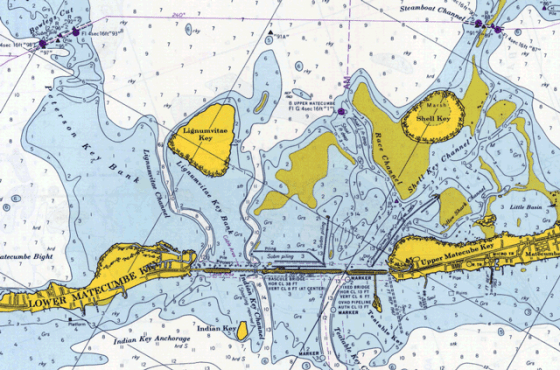
Unfortunately the lignum vitae has had a hard history in South Florida with the coming of large populations. It is an endangered tree. Its most famous habitat, the Lignumvitae Key, is protected. Such a state is a reminder that God created a paradise in South Florida, but man has largely ruined it, and not only from an environmental standpoint as well. In addition to the damage to the surroundings, living in South Florida is a sure cure for universalism, reminding one that, if there’s a default option in eternity, it’s not heaven.
So is the lignum vitae the tree of life that Adam and Eve saw at the start and John saw at the end? We’d like to think so. Some of us who are rooted in South Florida–and, of course, our counterparts to the south, where it is the national tree of the Bahamas, for example–would like to think that the place we call home is a reflection of the final place that God has prepared for us, one where the stain of human sin is washed away and we can hear the following: "’See! the Tabernacle of God is set up among men. God will dwell among them, and they will be his Peoples, and God himself will be among them, and he will wipe away all tears from their eyes. There will be no more death, nor will there be any more grief or crying or pain. The old order has passed away.’" (Revelation 21:3-4)
The only part that the lignum vitae doesn’t match up with its heavenly rendition is the matter of the fruit. Surely being planted next to the River of Life will generate that. So when you see the lignum vitae, think in terms of this being the tree you will see once again if you make it to heaven.
 Positive Infinity
Well, except for the part about the fruit of it giving eternal life, and the leaves being for the healing of the nations, and a different fruit for each month of the year, Sure, why not? Bottom line, yeah, people do have a way of making beauty into garbage. The plants, animals, landscape, the seas, and our own lives for that matter. It took the Creator Himself on a tree of death, to even make it possible to turn that trend around. Now we can be free, so let’s take hold of that freedom and work with Him to turn the garbage back into something beautiful, eh?
LikeLike